
The Invisible Side of Teaching: Why a One-Hour Fitness Class Takes Five
From the outside, teaching a fitness class looks simple.
I show up.
I teach for an hour.
Everyone sweats.
Then I go home.
That’s the visible part of the job.
But the truth is that the 45–60 minutes you see in the studio is only a fraction of the work it takes to create that class.
The hour you experience is usually only about 15–25% of the total work involved.
The rest happens quietly, behind the scenes.
Most of it is invisible.
What Students See
Students experience the finished product.
A well-structured class.
Music that builds energy.
Clear cues.
A sequence that flows naturally.
Maybe it’s a:
• Power Vinyasa class
• Pilates Sculpt workout
• Barre class
• Cycling class
• Bootcamp
The experience feels smooth and effortless.
But good classes don’t happen by accident.
They are designed.
What Students Don’t See
Behind every class is hours of preparation.
Programming the class
Instructors often design the entire structure of a class before they ever step into the studio.
That includes things like:
• movement sequencing
• intensity progression
• warm-up and cooldown design
• peak poses or peak intensity
• modifications for beginners and advanced students
• timing for each section
For instructors who care about their craft, programming can take:
30–90 minutes per class
Building the playlist
Music is a huge part of the class experience.
A great playlist isn’t random — it supports the energy and pacing of the class.
That often means:
• saving songs throughout the week
• screenshotting music ideas while driving (completely unsafe, do not recommend)
• testing songs against movement tempo
• adjusting song order to build energy
Playlist creation can take:
20–60 minutes
Practicing and refining the class
Some sequences need to be practiced.
Yoga flows, Pilates choreography, transitions between exercises — all of it needs to be tested.
That can include:
• physically practicing sequences
• refining cues
• adjusting pacing
• experimenting with variations
This can take:
20–60 minutes
Marketing and communication
Most instructors are also responsible for promoting their classes.
That includes:
• social media posts
• studio promotions
• responding to student messages
• creating flyers or graphics
• answering questions about class formats
Marketing often takes:
15–45 minutes per class
Continuing education
Fitness instructors are required to stay current with certifications and continuing education.
That includes learning about:
• anatomy
• biomechanics
• injury prevention
• new training methods
When averaged across classes, continuing education adds roughly:
10–30 minutes per class (not to mention the cost)
Travel, setup, and cleanup
There’s also the practical side of the job.
Driving between studios.
Arriving early.
Greeting students.
Setting up equipment.
Cleaning afterward.
This often adds another:
20–40 minutes
The Mental and Emotional Work
Another invisible part of teaching fitness is the mental and relational work that happens outside the class itself.
Great instructors don’t just lead workouts. They build relationships.
That means remembering:
• students’ names
• injuries or physical limitations
• personal goals
• preferences or modifications that help them succeed
It also means noticing when someone who usually comes to class suddenly stops showing up.
Many instructors quietly follow up.
They check in.
They ask how someone is doing.
They celebrate milestones and progress.
Over time, something deeper than a workout develops.
Community.
Connection.
Trust.
That kind of relationship-building takes attention, care, and emotional energy — and it almost never appears on a schedule or a paycheck.
But it’s often the reason people keep coming back.
The Real Time Investment
When you add everything together, the numbers tell a different story.
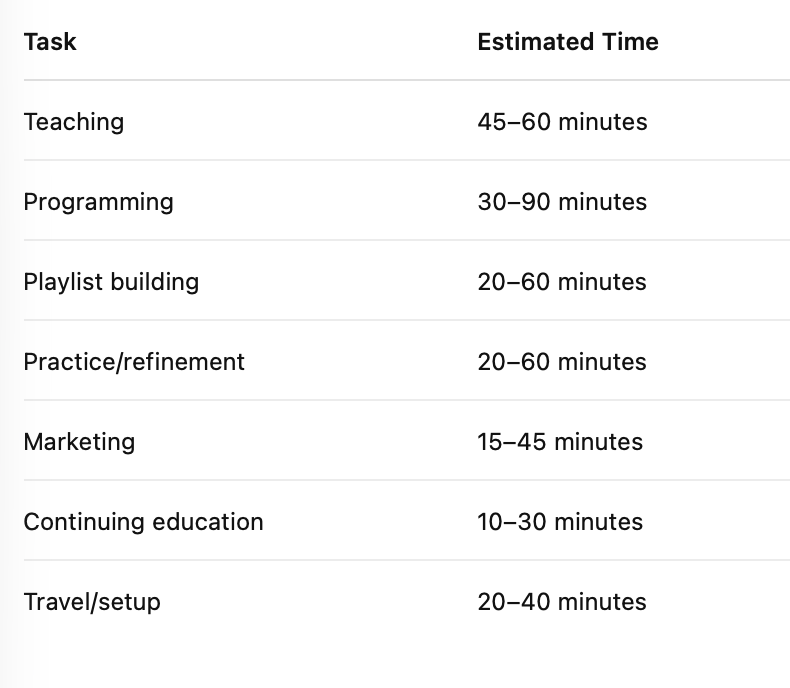
Total time invested:
3–5 hours per class
But the part people see — and the part that is usually paid — is the one hour in the studio.
The Percentage Most People Don’t Realize
If one class requires four hours of total work, the breakdown looks like this:
Paid teaching time: ~25%
Unpaid preparation and support work: ~75%
For many instructors, the numbers are even more dramatic:
15–25% paid time
75–85% invisible work
It’s one of the least visible realities of the fitness industry.
When a Part-Time Job Becomes a Full-Time One
Many group fitness instructors are technically considered part-time employees or independent contractors.
On paper, it might look like they only work a few hours a week.
If someone teaches 10–12 classes per week, the visible workload appears to be:
10–12 hours of work
That’s clearly part-time.
But when you include everything required to create those classes — programming, music, practicing, marketing, continuing education, and travel — the numbers change dramatically.
If each class requires 3–5 hours of total work, the weekly time commitment looks more like this:
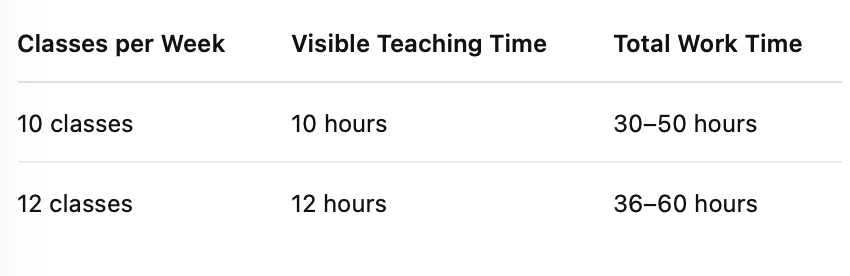
Suddenly what appears to be a part-time job is actually the equivalent of a full-time job or more.
The difference is that most of those hours are unpaid.
They are the invisible hours that go into making the class feel seamless, thoughtful, and intentional.
The Teachers Who Care the Most
Something else happens in this profession that most people never notice.
The instructors who care the most often put in the most unpaid work.
Not because they have to.
Because they want to.
The teachers who take pride in what they do aren’t just showing up and winging it. They’re thinking about their students long before the class begins.
They’re asking themselves questions like:
• Will this sequence feel good in people’s bodies?
• Is the intensity building in a smart way?
• Are there clear options for beginners?
• Will the playlist support the energy of the room?
• Does the class feel balanced when it’s over?
The teachers who care the most are the ones who:
• rewrite the class plan the night before
• test sequences in their living room
• spend an extra hour finding the perfect song
• study anatomy so they can explain a movement better
• design classes that feel intentional instead of random
Teaching, for them, isn’t just a job.
It’s a craft.
And when someone approaches teaching as a craft, they care deeply about details that most people never see.
Students might not realize how much work went into the class they just took.
But they feel the difference.
They feel it in the way the class flows.
They feel it in the music.
They feel it in the instructor’s presence and attention.
The invisible work is often what makes a class truly special.
The Invisible Work That Makes the Magic
Students experience the visible hour.
But underneath it are hours of planning, thinking, and refining.
The invisible side of teaching.
And while most of that work happens quietly behind the scenes, it’s what makes a class feel thoughtful, intentional, and meaningful.
Because great classes don’t just happen.
They are built.
And the teachers who care most are often the ones doing that work long before anyone walks into the room.
Final Thought
The next time you take a class, remember:
The hour you experience is only the tip of the iceberg.
Behind it are hours of creativity, preparation, emotional energy, and care — done so that when you step into the room, you can simply move, breathe, and feel good.
And if you look at the numbers alone, it doesn’t always make logical or financial sense.
Many instructors put in full-time effort for work that, on paper, looks part-time. They invest hours of unpaid labor designing classes, building relationships, studying their craft, and creating experiences for their students.
So why do they do it?
Because for many of us, teaching isn’t just a job.
It’s a calling.
It’s the thing we love to do. The place where our skills, creativity, and purpose meet.
We see people grow stronger.
We watch confidence build.
We witness small victories that become life-changing over time.
That kind of work matters.
The challenge is that society hasn’t fully caught up to valuing those contributions in a meaningful way yet.
But the impact is real.
Every class builds something bigger than a workout — it builds community, resilience, and connection.
And that is why so many teachers keep showing up, doing the invisible work, and giving their best to the people in the room.
Because even when the work is unseen, the difference it makes is not.
